The Legible Web
An essay on web technologies, like webrings, that people can see into and understand.
In 1991, Tim Berners-Lee published “HTML Tags,” a document that defined how documents on the World Wide Web were connected to each other. For Berners-Lee, those connections depended on the architecture of the <a> tag, a one-way link that takes the web reader from one document to another. A competing vision for how readers would move through the web showed up in Ted Nelson’s vision of two-way links as a method of traversal. Through his Xanadu project, a technology is proposed where you could always trace where a link came from, follow it, and see who on the other side is reading. This process of “transclusion” creates a legible relationship between author and reader.1 The two-way link, with every connection being visible, auditable, and legible to every user, encodes a certain politics into the technology itself.
I begin with Tim Berners-Lee and Ted Nelson not to suggest that one is better, or works for or against the idea of the web as a liberatory space. Both web pioneers arguably envisioned the web as a liberating, connecting force seen as a net-good in technological history. Tim Berners-Lee wrote, “I’ve always believed the web is for everyone”2 — envisioning it as a tool for connection. Ted Nelson sees computers and by extension, the web, as a one that centers human agency, “helping us understand the unprecedented danger of our future.”3 decades later, the web is far from the utopian vision that both Berners-Lee and Nelson envisioned. Critics like Shoshana Zuboff argue that “the internet… essential for social participation… is now saturated with commerce… [and] subordinated to surveillance capitalism.”4
How did we end up here? Going back to the differing views of traversal on the web, I propose that we take a closer look at the kind of politics that the one-way link vs. the two-way link encodes. In “HTML Tags”, Berners-Lee defines the <a> tag as having an HREF identifier points from document A to either another ‘anchor’ (this is what the a stands for) within the document, or in another document.5 I argue that this architecture (as opposed to Nelson’s) with its asymmetrical relationship between document and its anchor as an encoding of a certain politics into the technology itself. Langdon Winner describes what he calls inherently political technologies as “man-made systems that appear to require, or to be strongly compatible with, particular kinds of political relationships.”6 I do not think that Berners-Lee intentionally designed one-way links as a way to limit agency. Far from it, what I’ve read of him suggests that he is very much on the side of Web freedoms. Instead, the asymmetry created by the one-way link would encourage conditions where technologies that seek to uncover user data to track, profile and sell would emerge. In a world where Ted Nelson’s vision of a legible web where connections would be auditable from every node, there would be no reason for cookies, tracking pixels and other technologies of “surveillance capitalism” to emerge. In this essay I will examine three pairs of web technologies — the webring and the algorithmic feed, the hit counter and the Like button and the stable URL and the opaque link. I will argue that these technologies that run downstream from the <a> tag, in the ways that they are assembled together either work for, or against the vision of a liberatory web.
In order to interrogate further, I propose borrowing the methodology of affordance analysis from the fields of user experience and human-computer interaction, as a way to move past the question of intent and close-read specific web technologies. William Gaver describes affordance as how “the physical attributes of the thing to be acted upon are compatible with those of the actor.”7 The classic Don Norman example of this is that of the door handle. The vertical door handle is made for pulling, whereas a flat horizontal plate suggests a pushing motion to open the door. In digital interfaces, buttons with perceived depth and shadow indicate that they are to be clicked, rather than dragged or manipulated in some other way. In both examples, the form makes legible how the artifact works. Ian Hutchby extended this framework to media technologies by attributing digital interfaces to “having a materiality affecting navigation through a technically bounded interaction space”.8 Crucially Hutchby insists that affordances are “not things which impose themselves upon humans’ actions” but rather “set limits on what it is possible to do with, around or via that artefact”.9 This distinction matters because the question is not about whether a user can resist the taking away of agency, but what those technologies make possible or don’t allow for in the first place. Gaver further distinguishes affordances that are perceptible and those that are hidden, where the object does something that the user cannot see.10 Drawing on this framework, I use the term legibility to mean whether a user can see and understand what a web technology is doing, who controls it and what it does with their behavior. As we start to unpack our three pairs of web technology, I will ask these three questions to close-read how each technology works for, or against the liberatory web.
Traversal: The Webring vs. the Algorithmic Feed
The webring was a popular way of organizing like-minded sites in the late 90s and early 2000s. It is a strip of HTML that would show a bunch of links: Previous, Next, Random and Home. Clicking on these links would take you to sites that are part of this connected ring. You would find this strip at the bottom of a Geocities or (from what I remember) a few Myspace pages. In order for me to apply the heuristics analysis I outlined in the last paragraph, I had to find a webring online. In my research I had discovered a project called restorativland that restores “abandoned web ruins” in an effort to be a “gap between archival and visibility of the web that was lost”.11 What they had was an index of restored geocities pages, and that was where I started looking. I found an example of the webring on “Bluesbeard’s Homepage”.12
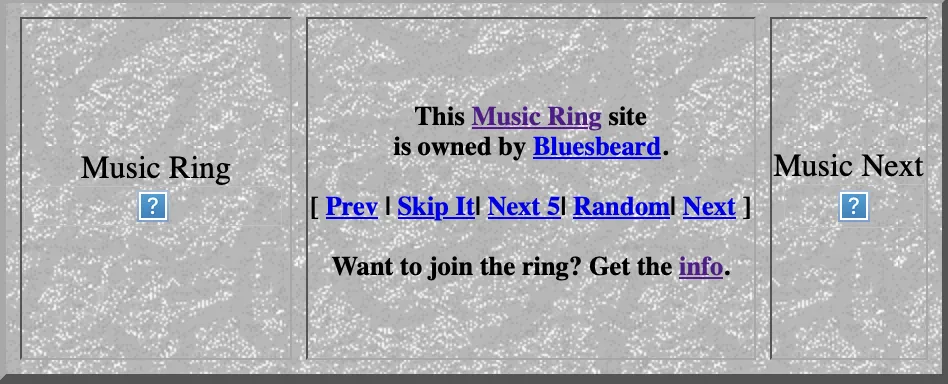
Figure 1.1 — The webring founded on Bluesbeard’s Homepage, “Blues in Italy,” showing broken links
Broken links aside, this was a great place to start my analysis. So, following the methodology I had laid out, I ask the following questions. What does it look like it does? It is a series of links that seem to take me to other pages. What does it actually do? When I click on it, it seemingly takes me to the domain webring.org, which appears to be defunct. I don’t think this is the intended behavior however, as inspecting the code seems to suggest that the Webring.org is the site that manages the organization of these links. What does it hide? The webring itself doesn’t hide anything, however its behavior seems to be lost to time. Clicking on more “info” takes me to a 404 page. Whose interest does it serve? I’m honestly unsure. I had come expecting this to be my liberatory example, however because it seems like the data that would enable the linking behavior was hosted on a now defunct service, it is hard to tell. This brokenness however, is something revealing. I go back to when I inspected the page source. I am able to see and take what I theoretically know about how this should have worked, and see exactly how it works. These are <a> tags that point to webring.org, that would redirect to the next page in the ring.
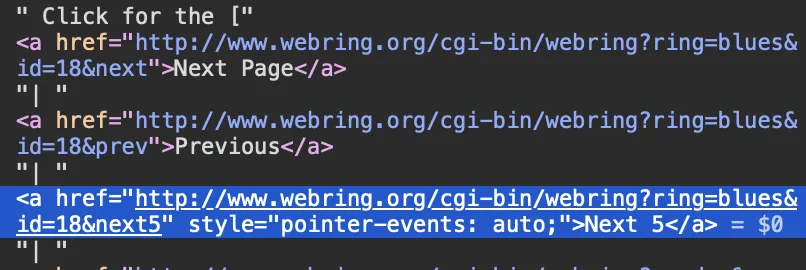
Figure 1.2 — The results of inspecting the source code of Bluesbeard’s Homepage, links out to www.webring.org, a defunct platform and backend of the webring on this page.
This is what Hutchby meant by the “materiality” of the digital artifact, and the structure of the thing itself pointing to how it functions even though the network it relied on is now defunct. I’ve chosen to pair the webring with the algorithmic feed, in this exploration of how web technologies can, through its legibility, provide users with more agency to understand and therefore use (and not be used by) it. The algo feed, like the webring, is what I call a web technology that allows traversal. The webring allows movement from like-pages to other like-pages, whereas the algo serves up like-content to like-content (although who determines this is more opaque than the author-centered model of the webring). For the purposes of this argument I choose to examine the Facebook feed as an example of this. I start by employing the same methodology as I did the webring. What does it look like it does? Logging on to my Facebook I see a series of content pieces. On each are actions that I can take: Like, Comment and Share. Hovering on Like surfaces additional emotions that can be attached to a post such as Love, Care, Haha and Angry. I will examine this closely later as we look at the Like button in our second grouping of artifacts to look at. The content pieces I see, I can scroll endlessly on, and new ones keep getting surfaced. What does it actually do? Serves me content for me to continuously scroll on. There’s really only one direction I can move which is to scroll down (or refresh). What does it hide? Doing the same exercise of inspecting the source code on a Facebook page from this year reveals how the feed gets constructed. Shown in the figure below are the divs that make up the feed. There are data attributes, and random classes attached. There are some patterns that indicate that perhaps these are classes that help style certain elements (posts, icons, etc.) but they are labeled in ways that make their meaning opaque to me (I’m not sure what the x1016tgk class is, or does).
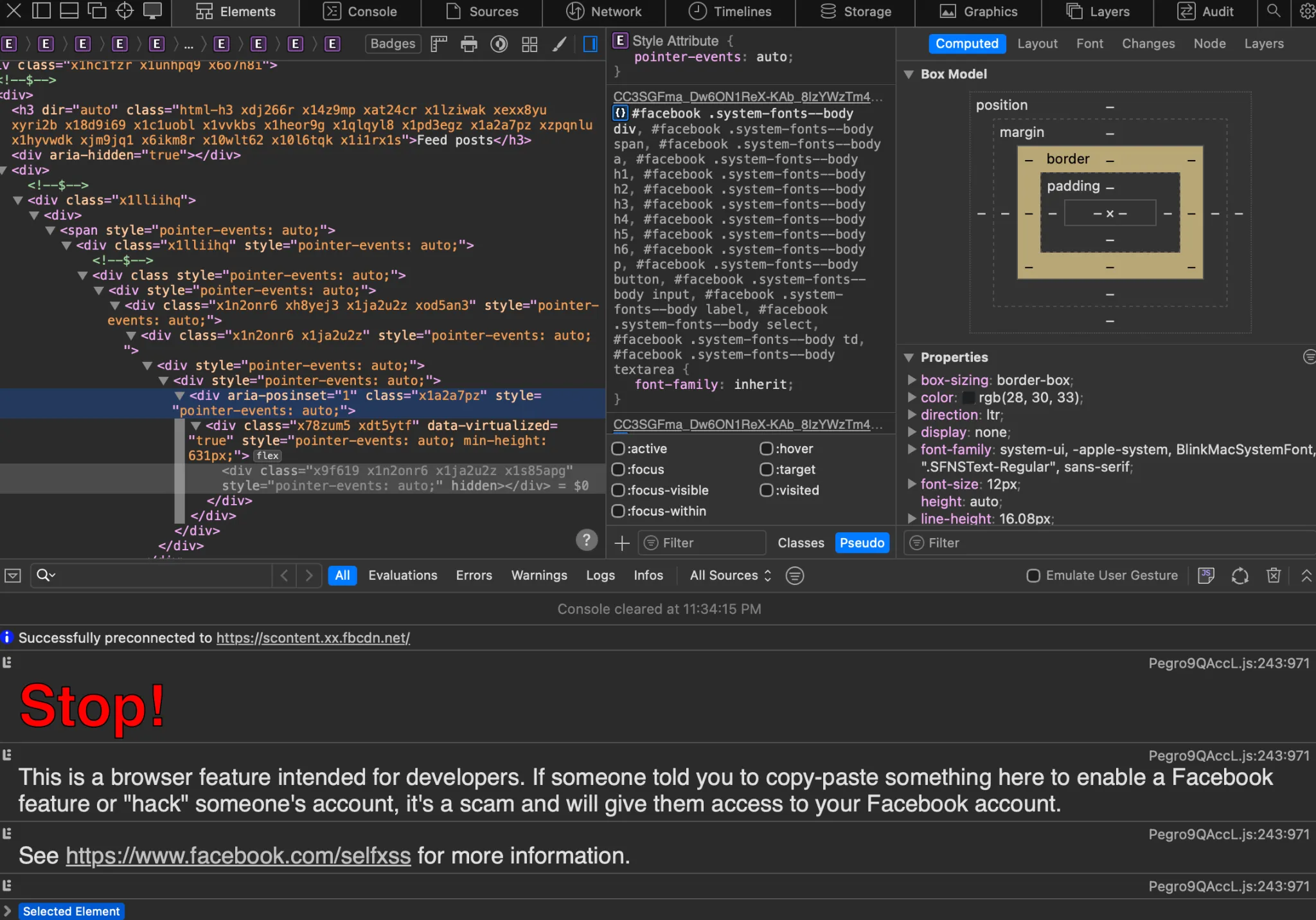
Figure 1.3 — Inspecting the Facebook feed both in its HTML structure, as well as javascript console logs shows preconnection to Facebook’s CDN but no visible logs for how posts are loaded
Jumping to the javascript console, I see a few actions happening. The first, is successful preconnection to Facebook’s CDN (content delivery network), and then a series of logs that seem to be a preventative measure from Facebook to prevent scammers from tricking people and doing nefarious things. What stood out to me, as I scrolled and scrolled, was not seeing any sort of logs pop up here. Not even a “new set of posts loaded” type log was created. The mechanism in which posts are recommended, and when and how they get loaded in seems to be hidden from even the pro user. Whose interest does it serve? The algorithm serves both content from those I follow, those adjacent to those I follow and also a few Sponsored posts. It is not new or controversial to say that perhaps the feed serves Facebook’s interests, and that of the advertisers on the platform. I left this audit more skeptical, as even in inspecting the source, it was hard to make sense of how the algo worked. The algorithm that composes the sequence of posts on someone’s Feed is named EdgeRank, after the way it “ranks relationships (‘edges’) between content and users, in order to decide which posts should show up on the news feeds of individual users.”13 In 2010, the EdgeRank algorithm was presented at Facebook’s f8 conference, as consisting of three factors – an affinity score between viewing user and edge creator, the weight for this edge type, and some time decay factor.
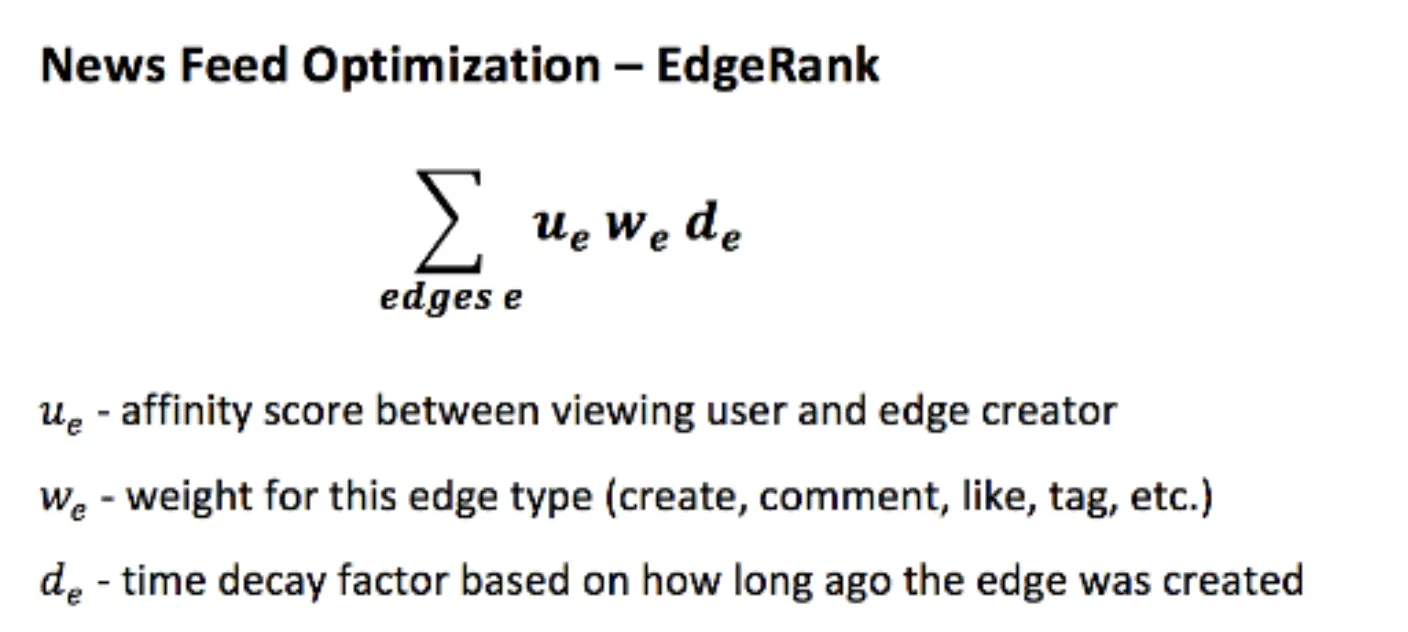
Figure 1.4 — The EdgeRank algorithm, and the three factors that it considers when it comes to weighing what a user sees.
Today’s algorithm on Facebook is far from the original EdgeRank algorithm, described as having “as many as 100,000 individual weights”14 as opposed to the three publicized in 2010. The sophistication aided by big data, machine learning and proprietary models taking what was already “work[ing] in the shadows”15 and taking it to new heights. My argument here of Facebook’s algorithm being an illegible and opaque technology in its structure, aligns with Birkbak and Carlen’s position that “there seems to be a task for critical social science to see algorithms as part of the so-called ’technologically unconscious, and reveal – or at least critique – their hidden power.”16 In contrast to the webring, the way in which the algorithm is powered by data structures, and processes that is opaque to the user makes it something that I would classify as not agency-giving based on its lack of legibility. A user cannot inspect their feed the way I inspected Bluesbeard’s Homepage. Even though the mechanism of the webring was broken, I was still able to see exactly how it would have worked. The Facebook feed, though, is working and invisible. This is the distinction between technology that serves the user’s understanding, and one that serves the platform’s interest in keeping its logic opaque.
Measurement: The Hit-Counter vs. the Like Button
I now shift to the second pairing. I go back to the primary source digital archaeology that I was doing on restorativland. Something that happened again that I was not expecting was to see the evidence of these technologies, but not the counter itself as a result of these old geocities sites using code that linked to now non-existent services. I found myself in “The Lair of Otaku Kamoko” (https://geocities.restorativland.org/Area51/Quadrant/1305/) a page created in 1999, with a hit-counter at the bottom. Much like the webring, the external site (aye.net) that would have enabled this from working was defunct. But the mechanism of how this works was super clear. This is an <img> that was pulled from the external site.
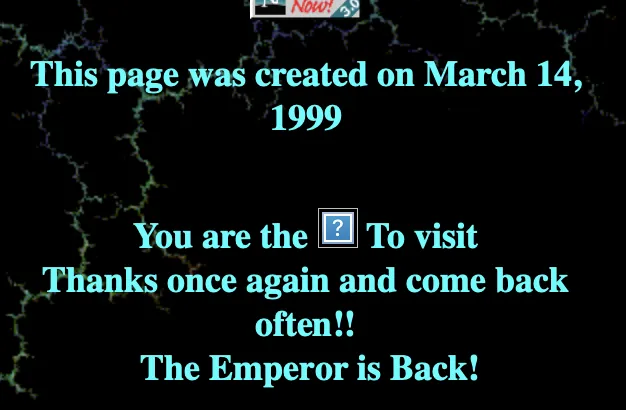

Figure 2.1 — A broken hit counter on “The Lair of Otaku Kamoko” with <img> tag which points to the now-defunct aye.net is still visible in the page source. Its mechanism is legible even in failure.
I did find an example of a working counter, after a bit of Reddit sleuthing on r/Millenials, on a DIY audio and electronics site. I was glad to have found a working version for my analysis, as perhaps it might give contemporary technology a fighting chance. So, what does it look like it does? It looks like it counted the total number of visitors since Jan 2001. Inspecting it, it looks like an <img> that was pulling from websiteout.net/counter.php, a page that offered hit counters in different styles, “free… without any pop-up ads… tested, optimized and compatible with all browsers… 100% compatible with W3C, HTML, HTM5, XHTML…secured and fully compatible with https and ssl… [and] completely cookie-free”.17 What does it actually do? Display an <img> of numbers representing total visitors. What does it hide? Nothing. Whose interest does it serve? The author, to provide that social proof to the reader that their page has value.
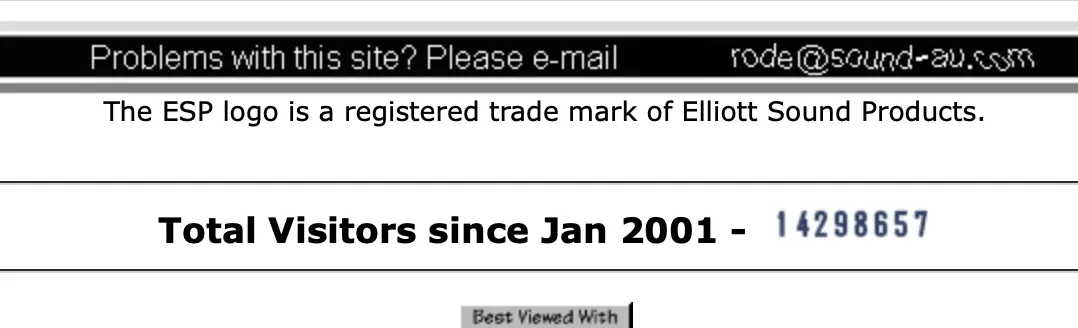
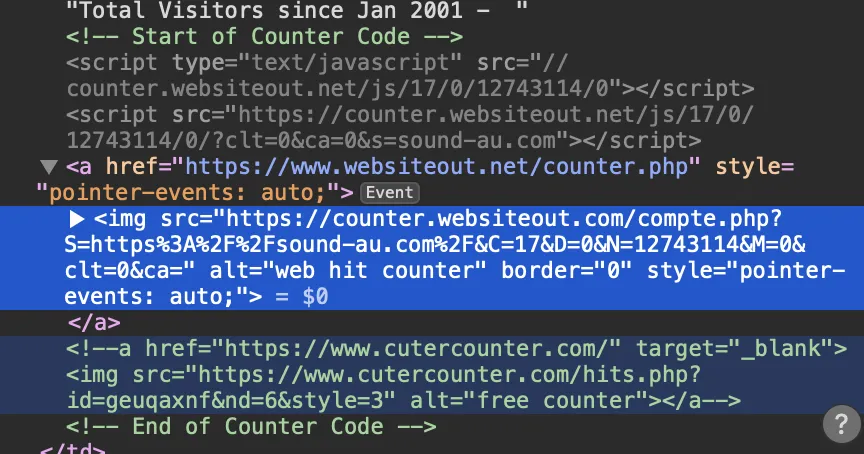
Figure 2.2 — A working hit counter on a DIY audio and electronics site, pulling from websiteout.net. The counter has displayed total visitors since January 2001, with no gap between what is presented and its source code.
The hit counter hides nothing. Its mechanism is the <img> tag that pulls from an external service, but what surrounds it in the presentation layer (or even in the comments in the code) makes it clear what it is doing, readable by anyone who cares to look. There is no gap between what it appears to do, and what it actually does. The Like button, introduced by Facebook in 2007, appears to do something similar, but I argue that it is an example of Gaver’s concept of the hidden affordance — something that presents itself as one thing, but does another. So, what does it look like it does? At face value, the Like button is a way for me as a user to put my stamp of approval on a piece of content. As of 2026, there are also additional ways to engage, not just with a Like but as mentioned earlier with Love, Care, Haha or Angry. What does it actually do? As discussed earlier, with the idea of weight types used in today’s algo (built on top of EdgeRank), it is a data collection instrument presented as an expression mechanism. What does it hide? Its role as a ranking signal with no way for a user to understand how their liking of a post contributes to how this content gets surfaced in someone else’s feed. Whose interest does it serve? Given that the Like button is a ranking signal that is part of how the algo serves up content, I would argue that it serves the platform. What looks like something that gives users a voice is instead the way the platform measures engagement and uses that data to predict, drive and manipulate behavior. Both the hit counter and the Like button measure attention. One puts that measurement clear and visible for anyone to see. It has no other function other than to count up. It is dumb by design. The other hides the mechanism of measurement, and uses it to serve up the platform’s advertising model. It is measurement infrastructure that pretends to be legible, but has a hidden motive, transferring power from the author/reader relationship to the platform.
Memory: The Stable URL vs. Opaque Platform Links
The last pairing I want to focus on is what I call the stable URL vs. the opaque URL. The URL stands for Uniform Resource Locator, an address that provides the unique specific location for things on the Web. Geocities took this literally, with the concept of neighborhoods and street numbers. Take the URL of Bluesbeard’s Homepage as an example. So, what does it look like it does? It identifies Bluesbeard’s Homepage as a place on the web. It is a restored geocities page, in the Sunset Strip neighborhood at 1009. What does it actually do? The same thing, and it makes this a thing that is easily archivable, cited and shared outside of the platform. What does it hide? Nothing. Whose interest does it serve? The public record. Now, what I plan on putting up as a foil here is the kind of URLs that have become more common on the modern web. You might have seen this as URLs with long strings of ? and =, different variables used for tracking, or for querying some part of the content from a database somewhere. In an article called “Cool URIs don’t change” Tim Berners-Lee argues that “a cool URI is one which does not change” framing the stability of a web address as both an aesthetic and an ethical commitment, as “the duty of a Webmaster.”18 Keeping this in mind lets turn to the last of our set of objects – the opaque platform link. Take the URL below, to 1987 global pop sensation, “Never Gonna Give You Up” by Rick Astley. An Internet classic.

Figure 3.1 — The Youtube URL for Rick Astley’s “Never Gonna Give You Up” which uses an opaque database key (?v=dQw..) controlled entirely by the platform.
What does it look like it does? It looks like it identifies a piece of content. What does it actually do? youtube.com/watch loads up the front-end, while the string of characters after ?v=, queries and loads up the content from a database somewhere. What does it hide? The name of the content, who owns it, a bunch of metadata that is presented in the frontend. Also, something I discovered while inspecting the javascript console while loading this page, is a Youtube ad tracking pixel failing to fire. In the figure below, there is a fetch attempt to googleads.g.doubleclick.net – the Google Ads infrastructure.
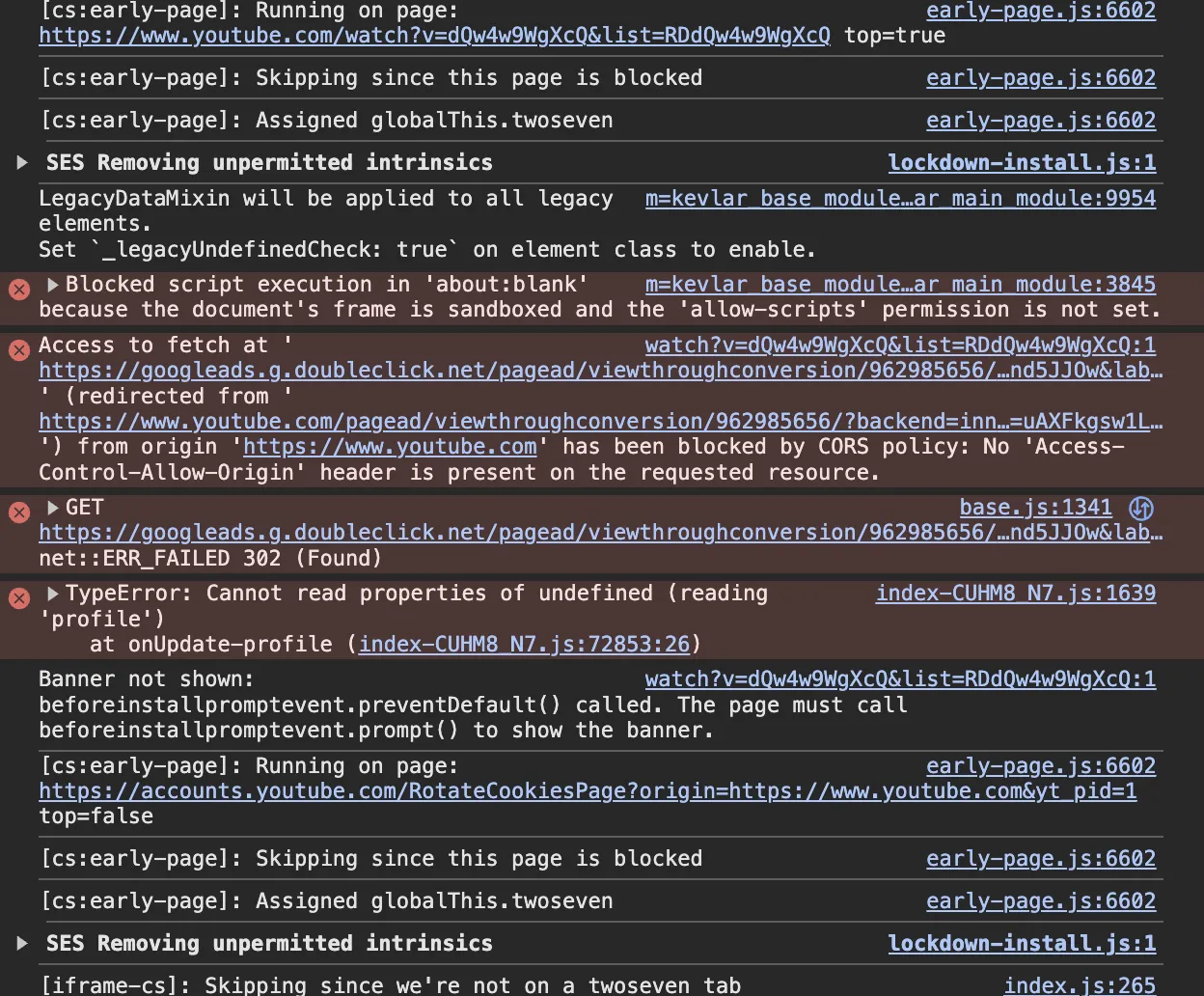
Figure 3.2 — Javascript console output captured on the Youtube page, showing a failed fetch request to Google Ads infrastructure. This tracking call is invisible to the user unless they inspect the console directly, an example of Gaver’s hidden affordance.
This is something hidden from the user unless they inspect, again a hidden affordance per Gaver. The page is doing something the user cannot see, which serves the advertisers. Who does it serve? The advertisers. Also, going back to the question of archivability, and this not being a stable URL, power is moved away from the public record to the platform. If Google decides to delete, database record “dQw4w9W…” then a user loading up this exact URL will probably get a 404. When we look at these two URLs, one identifies exactly where you are, who your neighbors are and what neighborhood you belong to. It acts like an address. The other one, uses a key to query content to load as well as any sort of tracking or analytics in the background. This key is controlled by the platform, and can be revoked at any moment.
Across all three pairings, the pattern is the same: technology that centers the user makes its workings legible, while technology that centers the platforms keeps them hidden. These are design choices that, as Winner reminds us, encode politics, regardless of the intention of its creator. Tim Berners-Lee’s one-way <a> tag wasn’t designed with malicious intent but its asymmetry created the conditions that were, as Winner describes, compatible with a certain political ideology. In this case, capitalism looks at that asymmetry and yields things like data collection, surveillance and other kinds of extraction (attention, traversal, etc.) that make up today’s web. What this analysis suggests is that liberation on the web is not a question of ownership, or regulation but rather a question of legibility. A user who cannot read what a technology is doing cannot meaningfully consent to it.
Bibliography
Berners-Lee, Tim. “Cool URIs Don’t Change.” World Wide Web Consortium, 1998. https://www.w3.org/Provider/Style/URI.
Berners-Lee, Tim. “HTML Tags.” World Wide Web Consortium, November 1991. https://www.webdesignmuseum.org/web-design-history/tim-berners-lee-published-a-document-called-html-tags-1991.
Berners-Lee, Tim. “One Small Step for the Web…” Medium, September 29, 2018. https://medium.com/@timberners_lee/one-small-step-for-the-web-87f92217d085.
Birkbak, Andreas, and Hendrik Carlsen. “The World of EdgeRank: Rhetorical Justifications of Facebook’s News Feed Algorithm.” Computational Culture, no. 4 (2016). http://computationalculture.net/the-world-of-edgerank-rhetorical-justifications-of-facebooks-news-feed-algorithm/.
“Bluesbeard’s Homepage.” Geocities, restored by Restorativland. Accessed April 2026. https://geocities.restorativland.org/SunsetStrip/1009/.
Constine, Josh. “EdgeRank Is Dead: Facebook’s News Feed Algorithm Now Has Close to 100K Weight Factors.” MarTech, August 16, 2013. https://martech.org/edgerank-is-dead-facebooks-news-feed-algorithm-now-has-close-to-100k-weight-factors/.
Gaver, William W. “Technology Affordances.” In Proceedings of the SIGCHI Conference on Human Factors in Computing Systems, 79–84. New York: ACM Press, 1991. https://lri.fr/~mbl/Stanford/CS477/papers/Gaver-CHI1991.pdf.
Hutchby, Ian. “Technologies, Texts and Affordances.” Sociology 35, no. 2 (2001): 441–456.
Nelson, Ted. Computer Lib / Dream Machines. Self-published, 1974.
Nelson, Ted. “Computers for Cynics 6 — The Real Story of the World Wide Web.” YouTube video, 13:06. May 28, 2012. https://www.youtube.com/watch?v=gWDPhEvKuRY.
Nelson, Ted. “Ted Nelson Demonstrates Xanadu Space.” YouTube video. TheTedNelson. https://www.youtube.com/watch?v=En_2T7KH6RA.
Restorativland. “About.” Accessed April 2026. https://restorativland.org.
WebsiteOut. “Free Website Counter.” Accessed April 2026. https://www.websiteout.net/counter.php.
Winner, Langdon. “Do Artifacts Have Politics?” Daedalus 109, no. 1 (1980): 121–136.
Zuboff, Shoshana. The Age of Surveillance Capitalism: The Fight for a Human Future at the New Frontier of Power. New York: PublicAffairs, 2019.
Footnotes
-
Nelson, Ted. “Computers for Cynics 6 — The Real Story of the World Wide Web.” YouTube video, 13:06. May 28, 2012. ↩
-
Berners-Lee, Tim. “One Small Step for the Web…” Medium, September 29, 2018. ↩
-
Nelson, Ted. Computer Lib / Dream Machines. Self-published, 1974: 3 ↩
-
Zuboff, Shoshana. The Age of Surveillance Capitalism: The Fight for a Human Future at the New Frontier of Power. New York: PublicAffairs, 2019: 15 ↩
-
Berners-Lee, Tim. “HTML Tags.” World Wide Web Consortium, November 1991. ↩
-
Winner, Langdon. “Do Artifacts Have Politics?” Daedalus 109, no. 1 (1980): 125 ↩
-
William W. Gaver, “Technology Affordances,” in Proceedings of the SIGCHI Conference on Human Factors in Computing Systems (New York: ACM Press, 1991), 79 ↩
-
Hutchby, Ian. “Technologies, Texts and Affordances.” Sociology 35, no. 2 (2001): 444 ↩
-
Hutchby, “Technologies, Texts and Affordances,” 453. ↩
-
Gaver, “Technology Affordances,” 80 ↩
-
Restorativland, “About,” accessed April 2026, https://restorativland.org. ↩
-
“Bluesbeard’s Homepage,” Geocities, restored by Restorativland, accessed April 2026, https://geocities.restorativland.org/SunsetStrip/1009/. ↩
-
Andreas Birkbak and Hendrik Carlsen, “The World of EdgeRank: Rhetorical Justifications of Facebook’s News Feed Algorithm,” Computational Culture, no. 4 (2016) ↩
-
Josh Constine, “EdgeRank Is Dead: Facebook’s News Feed Algorithm Now Has Close to 100K Weight Factors,” MarTech, August 16, 2013 ↩
-
Birkbak and Carlsen, “World of EdgeRank.” ↩
-
Birkbak and Carlsen, “World of EdgeRank.” ↩
-
WebsiteOut, “Free Website Counter,” accessed April 2026, https://www.websiteout.net/counter.php. ↩
-
Tim Berners-Lee, “Cool URIs Don’t Change,” World Wide Web Consortium, 1998, https://www.w3.org/Provider/Style/URI. ↩