TCARE Platform
Reduced time to care plan for family caregivers from 55 to 25 minutes
- Role
- Head of Product
- Scope
- Research, design, customer success
- Outcome
- Care plans in 25 minutes, down from 55, in one session instead of 2.5
About 1 in 5 adults help a loved one with daily activities and medical tasks. This is informal caregiving. In 2018, I met the team behind TCARE, a paper-based assessment for caregivers.
TCARE is built on Caregiver Identity Theory, developed by Dr. Rhonda Montgomery. Washington State has used it since 2006. In the state’s pilot, it delayed nursing home placement by an average of 21 months and cut Medicaid long-term care claims by 20%.
I was hired as the first designer, and eventually became Head of Product, to take what the paper assessment did and bring it to a digital platform. I worked as the in-between for our engineering function (our CTO and offshore engineering team) and the subject matter expert (Dr. Montgomery herself), brainstorming, scoping and outlining features. The software did the scoring, so case managers stopped printing forms and adding up scores by hand, and they could build the care plan during the session.
Time to care plan dropped from 55 minutes to 25, and caregivers reached the right resources in one session instead of two and a half.
What case managers told us
We started by talking to case managers who had been using the paper version. Four things stood out.
“When I come into work, I often times don’t know where to start. Which cases need me to take action? When by?”
“If we have to stop the assessment for any reason, my stomach turns, because we have to start this all over again next time.”
“I’d like to be able to have better contextual understanding of the caregiver before going into an assessment or follow-up.”
“The biggest time spent is identifying the best resources for the care plan. Can this be made easier?”
We mapped their day and wrote our open questions on the map. Could we get the assessment under 40 minutes? Could the care plan be ready before the session ended?
Four decisions
Where to start each day
Our first version only did the assessment. Case managers told us they started the day not knowing which cases needed them, so we added a Next Actions dashboard with the day’s and the week’s cases, and scheduling built in.
Stopping without starting over
Assessments get interrupted. On paper, that meant starting again next time. In ours, a case manager could save and pick up where they left off, and the screen showed roughly how long was left. It also flagged burnout risk as the scores came in. Case managers could rate each question with the number keys.
Knowing the caregiver first
Case managers wanted context before a follow-up. The caregiver overview tracked six burden scores across follow-ups and linked each caregiver to everyone they cared for. One person might be looking after a mother and a sister.
A care plan in the session
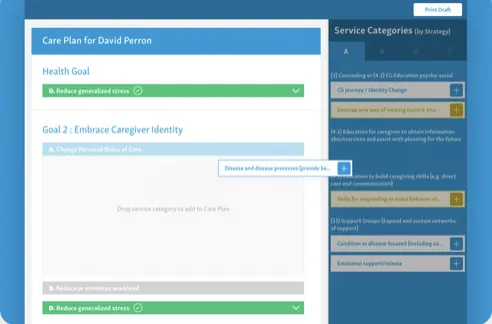
Finding resources took the most time. After the assessment, a caregiver gets one of three goals (to embrace, keep or move away from their caregiver identity) plus health goals. We automated the scoring and connected the plan to a resource database. Case managers dragged in strategies and resources, and the plan was done before the session ended.
What changed
Outside the agencies, the University of Wyoming used the platform as a research tool, so we built custom data exports for them. I ran a pilot on the platform that offered caregiver support to 50+ employees at a Fortune 500 company as a workplace benefit. Soon after, the platform supported our $3M seed round.
What I’d do differently
Our first users were case managers at Area Agencies on Aging, and many weren’t comfortable with technology. When the company moved toward insurance carriers, it lost some of that closeness. I think there was more to learn by staying with them.
Going digital also had a cost. A screen can come between a case manager and the caregiver they’re talking to, and I saw the same thing again at Ascension. If I did this today, I’d try a private model that runs on the device, like the Whisper model I used for Dubbing Studio, to listen to the assessment and fill in the survey. The recording would stay on the device, and the case manager could look at the caregiver instead of the form. I’d also want to ask caregivers how it feels to have a machine listening.
| Lane | 1Caregiver Capture | 2Pre-Assess | 3Assess | 4Post-Assess | 5Selecting Services | 6Deliver Care Plan | 7In-Waiting↺ back to Caregiver Capture |
|---|---|---|---|---|---|---|---|
| Key question | Bulk CSV upload | Better context before the assessment | Could we get the assessment under 40 minutes? | Could the care plan be ready before the session ended? | Supporting caregivers between assessments and follow-ups |
1
Caregiver Capture
Bulk CSV upload
2
Pre-Assess
Better context before the assessment
3
Assess
Could we get the assessment under 40 minutes?
4
Post-Assess
Could the care plan be ready before the session ended?
5
Selecting Services
6
Deliver Care Plan
7
In-Waiting
Supporting caregivers between assessments and follow-ups
↺ back to Caregiver Capture